Labels

Saturday, May 14, 2022

Mechanics of travel--the milk run

Blocked by restrictions during "the Covid Zone" just 8 days prior to boarding a transatlantic flight to start our Easter 2020 trip to Orkney and then blocked again for Easter 2021, our 2022 Easter sojourn this year seemed slightly anti-climatic.  That was not, mind you, on account of Orkney's spectacular scenery or her incredible ancient sites.  No.  Those were every bit as awe inspiring as we had hoped. 

Our Hyundai car hire aboard MV Varagan--April 14, 2022

It was just that while stuck in the Covid Zone, we had viewed and reviewed Ordnance Survey maps and travel guides to the point that they were dog eared with use.  Every possible place of interest in Orkney--its Mainland and Isles--was checked on the "see list".  We had a veritable encyclopedia of things to do.  Once there, however, a reality of scope and time set in.  

Perhaps we deceive ourselves in one sense becoming geographically chauvinistic.  Here in the Inland Northwest, Idaho County is over 8,500 square miles, the largest county in Idaho and 18th largest county in the United States.  Land as far as the eye can see.  

Whereas Orkney Island Council is comprised of some 380 square miles, all its islands taken together.  Mainland Orkney, where we elected to center our stay, may "only" be 202 square miles.  But that is land area.  There is also the North Atlantic, which cannot be dismissed in Orkney's life.  For it is omnipresent...as far as the eye can see.  And still further, beyond the evident circumference of the planet that bends the horizon line where the ocean meets the sky.

Commuters MV Shapinsay hoving into Rousay--April 15, 2022

Even at "only" 202 square miles, Mainland Orkney is remarkably dense with archeological sites and settlements that easily span over 5,000 years.  We thought in our previous sojourn at Easter 2019 to Scotland's  Kintyre Peninsula and Knapdale that Kilmartin Glen (which like Orkney has protected World Heritage sites) was dense with Neolithic sites.  Comparatively, it is not.

The Inner Isle of Rousay, for example, is called the "Egypt of the North" for its incredibly numerous historical sites that range from multiple and quite startling Neolithic cairns to Iron Age brochs, to Viking settlements and Medieval churches...and just plain interesting shoreline geography, even if one could ignore the seals.

In addition to Mainland Orkney, we visited five other islands--three Inner Isles and two North Isles.  We intended to make full use of the "poor man's ocean cruises"--which is to say the Orkney Ferries that operate inter-island from Kirkwall pier (to the North Isles) or from Tingwall pier (to the Inner Isles).


Construction crew bound for Egilsay--April 15, 2022

A small passenger only ferry does operate from Stromness (Mainland Orkney's "second port city") to Moaness (on north Hoy).  And from Houton pier on Mainland Orkney's south coast is the ferry terminal for Flotta and Lyness (on south Hoy).  We did not visit Hoy during our tour (even though it had several check marks!) We lacked time.  

Excluding Orkney Mainland, five islands on our itinerary were respectively--Rousay (we brought the car hire over), Egilsay and Wyre (both done on foot),  Eday and Sanday (both with the car hire).  

We incurred extra ferry fees for the privilege of bringing the car (+/- £25 for the vehicle round trip).  Normally, we would not have considered taking a car hire onboard, it being something of a hassle to do, with an extra fee.  But again, the scale of the islands for the foot bound is somewhat deceptive.  Plus the ocean between them, and the time required to sail over it, required that we economize our time on the larger isles.  

Royal Mail van waiting at Rousay--April 15, 2022
Had we not done so, we could not have toured the larger islands in any meaningful way.  Bus service is basically non-existent on them (at least over Easter tide)...despite what online travel guides may say.  

Even with a car, we still had to foot from parking places to most sites we visited...so the premium was time.  We opted to economize our time by bringing the car hire to the larger outer islands.  Bringing the car hire over for Egilsay and Wyre, however, made little sense since both are quite small.  So we footed those.

The pace is greatly muted in these islands.  That said, these islands are not exempt from modern currents like amazon prime...though it may arrive over water by ferry.  The isles remain very much connected to the modern world, just at a slower pace.  

Royal Mail
The transfer of mail and parcel packages from the MV Shapinsay was interesting.  We boarded MV Shapinsay as foot passengers Friday, April 15th, having no need to bring the car hire given the small size of the islands we were set to explore.  We were bound for a half-day walk on Egilsay the first half of the day.  Egilsay is a small island of 2.5 square miles. Then, just after noon, we reboarded the MV Shapinsay from Egilsay and sailed to Wyre, an even smaller island of 1.2 square miles, for the remaining half-day walk.  

Both Inner Isles can be done easily enough and with time to spare...if one takes the earliest Mainland ferry out from Tingwall.  

The Inner Isles ferry runs something of a triangular route.  Rather than mooring overnight at Tingwall on Mainland, curiously, the ferry moors at Rousay.  It makes its early morning run to Egilsay and then to Wyre and back to Rousay.  Apparently it is collecting up the commuters and probably the school kids.  It then departs Rousay for Tingwall, and there begins the six daily runs from Mainland Orkney to the Inner Isles.        

Milk crate and amazon bound for Wyre--April 15, 2022
We remained onboard at Rousay in any case, since we were traveling through.  We had no need to touch foot on Rousay as it were.  We would be back on Rousay the very next day...with our car hire to tour it.  Rousay is some 19 square miles.  

As we waited for the deliveries to be transferred, we watched the mail with some fascination.  It was a mix of modern (evidenced by the amazon prime boxes) and quaint (evidenced by the milk crate).  

It seemed an anachronism, but literally the ferry was making the milk run.   

The U.K.'s Royal Mail is one of those legacy types of establishments.  While it would be familiar to us in some respects, at the same time it is different.  Royal post offices, for example, are generally privately owned businesses or franchises in the U.K.'s small isolated communities.  Royal Mail provides service, in itself a long lost tradition that has all but disappeared in hyper-modern and indifferent America.

That milk, incidentally, was bound for the isle of Wyre, just across the channel from Rousay.  The ferryman set the milk crate on the pier ramp at Wyre.  We watched three young boys (residents of Wyre are called "Whelks") vie for who got to carry the milk home...apparently a privilege.  It looked like the middle boy succeeded in claiming it.   

On our return to Tingwall that evening from Wyre after our final half day walk, a gentleman debarked from MV Shpainsay with youngsters who filled his station wagon.  He stopped to pick up the remaining milk in the crate before apparently heading home to one of the homesteads on Wyre.  


MV Shapinsay ferry delivery--April 15, 2022

For all intents and purposes, our planned island excursions (by keeping our base at Kirkwall) each consumed a full day.  Egilsay and Wyre, because they are diminutive, constituted between them a single day trip.  But that was possible only because the relatively busy Inner Isles ferry schedule permitted it.  In general, touring the larger isles means setting off from the Kirkwall pier in the morning and returning in early evening.  

If anything, we overestimated our physical resilience.  While we got back to Mainland Orkney with daylight to spare after our day hikes, we were ready for dinner and an Orkney Brewery beer.  So short trips to catch other sites on Mainland after those day hikes on other islands were...overly ambitious.  Bottom line, a number of places we had eagerly checked off while stuck in the Covid Zone as "possible" when we returned to Mainland Orkney from our day trips...remained unvisited.  We will say simply we had a poverty of riches.  That is to say more sites to see than time to see them.  Limitations.  

In any case, without dispute our tour in Orkney was spectacular, often quite spiritual.

MS Spitzbergen at Kirkwall--liner season begins April 14, 2022

Another word on those Orkney Ferries.  Besides their surprisingly inexpensive passenger fares (you need not take a car over--we did for the reasons stated above), these daily ferries ply between Orkney's islands and have a certain life to them, a vibrancy, a flavor.  That is a principal reason we travel, after all.  

MV Varagan pulling out of Kirkwall for Eday--April 14, 2022
The Orkney Ferries are about every day islanders, their culture, their world.  Locals mostly, workers or tradesmen with perhaps a few off-season tourists like us aboard at Easter tide.  We absolutely enjoy this "off season" time of year in Scotland. 

The Orkney Ferries are entirely unlike the massive "warehouses" called cruise ships, the "industrial scale" tourism.  I would argue the Orkney Ferries are every bit as fun.  Certainly more authentic and far less spendy.  views of the islands are every bit as blue hued from them as from a porthole on a cruise liner.  More so even, since one can experience the salt and brisk air on them.  

The whole of our Scotland 2022 Easter sojourn was 15 days, start to finish.  Several of those days necessarily were allotted to long distance transportation.  This year, we relied upon Scotrail--its spectacular Highland Main Line and the Far North Line. 

Of our 15 day excursion, we had 10 days to spend in Orkney, choosing to "station" the majority of our trip in Kirkwall with the exception of a couple overnights on Sanday at the end of our Orkney visit.  Honestly, it is difficult to imagine attempting this trip and spending any less time than we did to take it.  There is so much there.  

Those sidling up to Hatston pier aboard packed passenger liners only to be herded into a quick dash of shore time in an aimless amble on Kirkwall's quasi-pedestrian Albert Street to St. Magnus Cathedral and back to the pier hardly see Orkney.  They don't experience it.  That is true even if one throws in a premium full tourist bus from their warehouse moored at Hatson pier to herd through the chutes in the "Neolithic Heart of Orkney" and be prodded through a queue of Skara Brae.  Again, there is so much to Orkney.  So much more.


Tresness on Sanday--April 19, 2022

Sands of Cata, Sanday--April 19, 2022


Tuesday, May 3, 2022

A long shadow--Culloden

Culloden.  The very word evokes almost a hushed silence as it falls from the lips...yes in reverence to courage.  But also in memory of the sorrow of indefensible loss, the near obliteration of the Highland way of life and the incalculable pain by the Crown's response--forced eviction in the "Highland Clearances" and oppressive edicts designed to do away with Gaelic culture altogether.

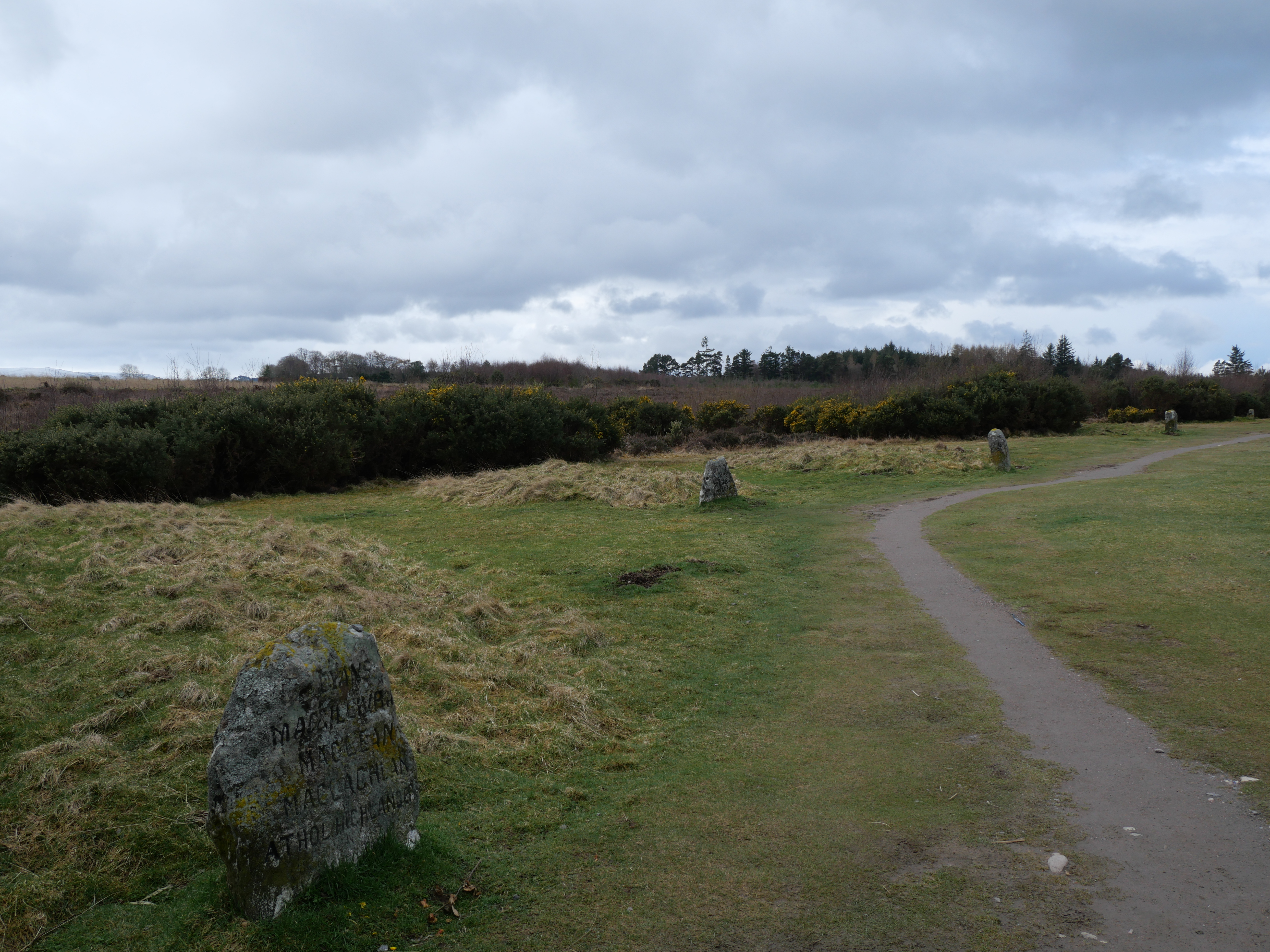
Mass graves of the Clans--Culloden April 9, 2022
Culloden was a tragedy in every sense of the word.  "Bonnie Prince Charlie's" vain pretense to the throne of Great Britain died at Culloden on April 16, 1746.  Unfortunately, his royal ambition took to the grave nearly 2000 Scot Highlanders along with it at Drummossie Moor, now generally called Culloden.

According to Historic Environment Scotland: "There is little doubt that Culloden is one of the most emotive battles to have been fought in the UK."  Emotive?  Aye.  No denying and far more.  Culloden "cast a long shadow" as historian Murray Pittock with the University of Glasgow puts it.  Its shadow is still cast.   

On the thankful side, Culloden is the last pitched battle on Great Britain's soil.  The battle is also a testament to the inadvisability of having a prince (or aspirant king) lead troops in battle. 

Not until after June 24, 1859 would the advice to keep princes out of the battle take hold in Europe.  Hindsight after horrific losses under Austrian Emperor Franz Joseph at the Battle of Solferino during the Second Italian War of Independence.  300,000 troops were engaged.  Suffering of the wounded left on the field literally to fend for themselves (the military custom of princes in that day) was so terrible, the Swiss merchant Jean-Henri Dunant who had ministered aid to Solferino's abandoned wounded would ultimately drive the enactment of the Geneva Conventions and establish the International Red Cross.

Leanach Cottage, Culloden, April 9, 2022

Culloden had its princely horrors in the shadows too...the sufferings, suppression and genocidal massacres afterwards.  It is said, in one example, Duke of Cumberland (e.g. Prince William, third and youngest son of Hanoverian King George II of Great Britain) pointed at a wounded highlander, apparently at Lieutenant Colonel Charles Fraser, after the battle at Culloden and directed Major James Wolfe to shoot him.  Wolfe refused, reputedly saying that his commission was at the disposal of the Duke...but not his honor.  Wolfe incidentally would go on to glory in the French and Indian War in America, dying on the Plains of Abraham below Quebec on September 17, 1759 in victory over the French.

Some always seem willing to carry out dark deeds in war.  Upon Wolfe's refusal, the Duke commanded a private to shoot the highlander.  So he was.  Government troops were sent across Culloden battlefield to bayonet all surviving Highlanders, wounded or otherwise, earning Cumberland his epithet, either "Sweet William" or "The Butcher" depending on one's sensitivities.  Over next several years, some 80 Jacobite were hung.  Hundreds more were sent as slaves to the sugar plantations in the Caribbean. 

Well of the Dead, Culloden April 9, 2022

Culloden was, but it should not have been.  Bonny Prince Charlie and his advisors chose the battleground at Drummosie Moor (against advice from the Jacobite's able Lord General John Murray).  And while Prince Charlie chose it, the government troops defined its  range by its massed its artillery--ten 3 pounders and 6 mortars--behind the Government's forward line.  

The Jacobite had more or less been successful in all their battles during "the 45" uprising--except their last at Culloden.  Success and ambition have a way of distorting things, true then, true now.  The reality then was that the Jacobite army was exhausted on the day of the Culloden battle, poorly provisioned, dispirited, in dissension and...outnumbered.  It was in no position to offer a set piece battle that day at that hour.  Highland reinforcements had yet to arrive, as the Jacobite army began to take up its positions at Culloden.  

Among the strategies suggested was to break off contact, move to the northern Highlands and to carry out a guerilla campaign to give the army time to refurbish and resupply.  This would not, however, get Bonnie Prince Charlie to the throne.  And it was all about Bonnie Charlie.  So, Prince Charlie formed up on the battleground suggested by his Secretary, Sir John William O'Sullivan, the adjutant and quartermaster general of the Jacobite army.  Remaining at odds with that choice, Murray went on record.  He believed the moorland would nullify the one battle tactic Scots had--it would hamper a Highland charge.

Location of the Jacobite Line, Culloden, April 9, 2022
To offset their disadvantages, the Jacobite attempted a surprise attack during the night of April 15th.  About 4,500 Jacobite set off to strike Duke of Cumberland's army in camp, some ten miles distant.  The night march was chaotic and slow.  It was called off before dawn.  The Duke awoke his army at 4 a.m., prior to arrival of the struggling Jacobite units.  With the element of surprise lost, Jacobite troops returned to Culloden...hungry and exhausted.  At 5 a.m., the Duke put his army to field.  By late morning, about 11 a.m., the two armies came into view of each other, and formed into their battle positions by 1 p.m.  

A few minutes later, artillery fire was exchanged, initiated by the Jacobite without effect.  Unlike the Jacobite, however, government gunners were well-trained under William Belford, part of the first generation of artillery officers to be promoted based on merit, not political connections.  The government's artillery wrecked havoc on the Highland lines for half an hour.  Prince Charlie delayed because he anticipated the Government line would advance.  They did not comply with Charlie's assumptions.  So, a great part of whatever field advantage he presumed he had was abandoned.  Unable to sustain the Government's artillery fire on his Highlander lines by further waiting for the Duke to advance, Prince Charlie ordered the clansmen forward...across the boggy terrain of Drummosie Moor directly onto the Duke's killing field, which was ranged by effective artillery fire and massed muskets.

Highland cattle grazing to recreate bog, April 9, 2022
Recent geophysical surveys and metal detection sweeps indicate that Culloden's courageous Highlanders had, even so, came much closer to breaking the government lines in the "Field of the English" than has once been assumed.  Some fought their way, temporarily, to the second line.  Those who survived the charge across the moor collided with government line about 5 minutes after the advance was ordered.  

They closed in ferocious close quarter combat, but the Battle of Culloden was decided within fifteen minutes of the Highland charge even being ordered.  From start to finish, the battle lasted less than an hour.  

An hour...it cast a long shadow.  Archaic weapons with antiquated tactics were simply no match.  Culloden had changed everything.  

Government line from enclosure, April 9, 2022

Not all agree with this "older" characterization of Culloden as a battle between a professional army with artillery and muskets beating wild Highlanders with swords.  Battlefield archeological research now suggests the Jacobite had far more muskets than was once assumed.  They were well supplied with Spanish and French muskets.  

Positions of opposing infantry fights have been determined by metal detection because of the difference in caliber between the Spanish and French supplied muskets of the Jacobite, and the the British "Brown Bess".  That is not absolute, however, since the Jacobite also deployed British muskets taken in earlier "45" battles.  

A reversal in roles has been suggested.  Rather than Royal muskets cutting down Highland swordsmen, it has been speculated that Royal Dragoons (i.e. British swords) cut down Jacobite musketeers.  Perhaps.  That may be too fine distinction.  Horse in that day were used to flank lines, reconnoiter and finish the fight, or prevent their own lines from being flanked.  The Jacobite infantry began a retreat at 1:50 p.m.  Immediately upon their retreat, Government dragoons were set loose to flank them, to turn what was a Jacobite defeat into a strategic rout.  The Government dragoons succeeded in their mission.  Further, it cannot be ignored that Government artillery forced Prince Charlie to order the disastrous charge over Drummosie Moor rather than hope to lure the Duke's army toward the waiting Highland swordsmen, Jacobite muskets or British horse notwithstanding. 

Culwhiniac enclosure, Culloden, April 9, 2022
Our visit to Culloden came a week shy of the battle's 276th year commemoration.  Little doubt, we had similar weather.  The fighters at Culloden are said to have endured "a howling, freezing gale, on Wednesday, April 16, 1746."  Our Saturday, April 9th visit was also cold, a very blustery day of mixed skies.  

Blue skies attempted to break through; but each time they tried, they were hurled back by cells of sleet and hard kernel snow.  It was disorienting, near the edge of hypothermia.  The wind found ways around our sleeves, collars and pant legs to rob anything that might resemble body heat.  And in a final act of contempt of our presence on the battlefield, it pelted us with hard snow or stung us with wet sleet.

We had wanted to walk to the Clava Cairns from the battlefield, but low-lying snow squalls concealed the route and direction over the River Nairn, which we would have needed to cross.  I won't call these squalls fog.  No fog packs that much wind in it.  We opted for the bus back to the warmth of our accommodations in Inverness. 

Memorial Cairn, Clan Cemetery, Culloden April 9, 2022
Having walked Culloden, its "long shadow" is understandable.  While at the Battlefield Cairn, we spoke with a Scot family, three generations of them actually.  Beyond routine casual comments about the battlefield, our respective homes, and events so similar today (like Ukraine) the older gentleman chuckled that he remembered coming here as a youth.  His son, now a middle aged man, was taking picture of his sons, who posed at the memorial cairn like he did years ago. The cairn was erected by Duncan Forbes in 1881 in the Clan Cemetery to memorialize the fallen Highlanders.    

Culloden is now an inalienable part of the Highland people.  Its lines woven into the very fabric of their generations.