Labels

Wednesday, February 22, 2023

Resignation out of necessity

Some word is probably warranted at momentous turning points as this.  We live in historic times to be sure.  Though, it is often not so easy to tell that from our vantage in harried every day living.  Taking in the view (orienting the map so to speak) goes unnoticed in the clutter of cares.  

On occasion, it is rewarding just to pause awhile to appreciate the vista.  This we hope to do soon, to pull up and span the landscape of Eildon Hills from Scott's View.  Scott's View was a way stop for renowned Scottish writer Sir Walter Scott as he went about his business in the Scottish Borders.  It is said, so common was Sir Walter's brief pause at his favorite view that the horses pulling his hearse from his home at Abbotsford to his final resting place at Drybugh Abbey eerily stopped at Scott's View without command.  A last view, it is said.  

Since time immemorial the Eildon Hills have been the stuff of folklore.  Well before the arrival of the Romans by several thousand years, the Eildons were considered portals to the enchanted lands of the fairy folk.  In any case, following Sir Walter's lead, each of us should take more time to reflect...meditation instead of medication.        

As for reflecting upon Scotland's near term political future, the word "surprising" comes to mind.  No other word describes the recent resignation of Scotland's longest serving First Minister (FM) Nicola Sturgeon. After 8 years at the helm, FM Sturgeon's resignation was undeniably a surprise, a Valentine's massacre of a sort.  No one was prepared for it.  Nor is Scotland well prepared for the outcome of the constitutionally mandated election, currently ongoing, to replace FM Sturgeon.  Scotland has until March 27, 2023 to decide where it will stake its future.   

These observations should be tempered.  Native Scots may well bristle at comments from abroad about their parliamentary doings at Holyrood.  Still, we humor ourselves as having accumulated at least a small opinionated voice in regards to Scotland's political affairs, having been many times to Scotland on our Easter sojourns.  As an aside, Holyrood is a "metonym" for Scotland's government.  It is similar to using Washington when referring to America's government.

With that grammatical note made, my opinion of FM Sturgeon's tenure is less than genial.  Sturgeon's government (under her SNP--Scottish National Party) has made a horrible mess of just about everything they've had their hand in...including the latest constraints upon grammatical pronouns it seems.  It is inexplicable, almost bizarre really, that Sturgeon's tenure in office would end in ruin upon the senselessness of a reactionary New Age cultural war...the garbled straits of "transgenderism".  "Woke" gone amok.  

The sad part is, it is not as if Scotland has no other more pressing needs to attend.  But, reactionaries do what they do.  Reactionaries, whether American, or Scottish, or any other, seldom afford themselves much in the way of reflection or meditation.  That's why they seem to always end up in messes. 


As to messes, the CalMac ferry contract comes to mind.  Ignoring the highly questionable aroma of kickbacks and contract corruptions, the people of Scotland's isles rely upon ferry transportation.  In many cases it is a matter of dire need, sometimes life or death.  Comparatively then, the fanciful reconstructions of pronouns (or for that matter re-plumbed personal bodies) do not even make the list of noble pursuits or sensible governance. 

Meanwhile, the necessary construction of two CalMac ferries remains five years overdue and some £112 million overrun.  FM Sturgeon's young protege, Finance Secretary Kate Forbes, has continually shifted goalposts on the ferries.  No end in sight.  This debacle notwithstanding, Secretary Forbes (now on maternity leave) may be considered Sturgeon's most likely replacement come March 27.  SNP options are thin.  So it will either be Forbes or Deputy First Minister John Swinney.  For his part, Swinney promises a "rigorous approach" to the ferries that remain in the now nationalized Ferguson docks on the Clyde.  Taking on the role of Acting Finance Secretary (with Forbes out on maternity leave), "rigorous" Swinney permitted Ferguson shipyard to miss its deadline for filing its annual accounts.  And so it goes.

[Editor note:  On March 27, the less than competent minister Humza Yousaf was elected as FM for the SNP, Forbes placed second, and Mr. Swinney stepped down.]  

If it were only the ferries, maybe one could ignore.  But it's also bus lines, with routes being eliminated and possible strikes and protests over losing access to rural local public transportation.  Then, there's Scotrail, a rolling mismanagement that is now nationalized.  Its trains are vital to Scotland's economy.  They are also under rolling labor strikes.  Ditto the Highland airports.  To put it mildly, public transportation in Scotland is in disarray.  Then there are the teacher strikes, and the nursing strikes. 


FM Sturgeon could find nothing more pressing than to introduce transgenderism and continue to push an independence referendum despite the UK court's clear rejection of Holyrood's authority to do so?  Despite the 2014 vote (which rejected the SNP independence drive), it was understood that that would be a once in a generation vote.  Ah, but the SNP further shifts the goalposts.  Short generations in Scotland it seems...unless you're talking about the delivery of crucial ferries.

Bottom line, FM Sturgeon's resignation was the only way she could extricate herself and retain any dignity at all.  It's been 8 long years of nothing but a mess in the guise of forcing an ill-thought independence--one in which the SNP would of course remain in power.  Sensible or effective governance is apparently beyond the SNP's abilities.  It too should step down, en masse.  Roll up the banners. SNP clearly cannot handle basic governance over public transportation, public health, public education... 

So, what to do?  Paper over inadequacies and push an incomprehensible transgenderism bill.  That also failed, and so FM Sturgeon had no other way out, her resignation being too little too late.  It was illogical to push to be a new sovereign nation, not when so many of Scotland's basic needs have not been met by the very same political party seeking to manage Scotland's independence.  

By way of example, their latest independent plan calls for continuing use of the British pound until the SNP can come up with some sort of currency.  Maybe Bitcoin?  As if that's working well.  If CalMac ferries are any indication, an independent currency will take years upon years at an ever increasing cost.

Perhaps Holyrood should join us in our reflections at Scott's View.  Besides, tales of fairy folk in the Eildons are no less fanciful than depending upon the word of the SNP.   

For he that does good, having the unlimited power to do evil, deserves praise not only for the good which he performs, but for the evil which he forbears.--Sir Walter Scott.              


Friday, January 13, 2023

Birds

"Rommel, you magnificent bastard! I read your book!"--George C. Scott in the epic 1970 film Patton.

There's no use avoiding it.  A prefatory admission is necessary.  This post examines an uncouth  subject--politics.  And while not always completely unsullied by an occasional jaded jibe in previous commentaries still, in general, this blog avoids politics altogether.  That boorish subject is akin to a transmittable contagion, where intelligent discussion ends on life support once bitten.  

We prefer more enlightening genres like Scottish sojourns; archeological sites; historical subjects; and folk wisdom when it may be found.  And humor, it is hoped however vainly.

Politics is an uncomfortable subject best avoided around the table.  It is also true that one cannot always avoid it.  Thus, modesty compels me to request a fig-leaf to conceal undue embarrassment for even mentioning politics in polite company.  My fig leaf is requested in the ambition that perhaps something may be learned.  So with forlorn hope, an age-old axiom is sorely needed today--simply:  learn from your foes.


Exactly how long this axiom has counseled human kind is not knowable.  It's been around awhile, Patton notwithstanding.  Book of Proverbs alludes to it.  And its fullest expression is found as early as Aristophanes, the Ancient Greek playwright, in his 414 BC comedy "Birds":

Men of sense often learn from their enemies. It is from their foes, not their friends, that cities learn the lesson of building high walls and ships of war; and this lesson saves their children, their homes, and their properties.

Aristophanes' Birds took second place in the 414 BC festival at Dionysia in Athens.  Indeed, Aristophanes often took second place with his theatrical comedies--2nd place in 427 BC with The Banqueters; second place in 421 BC with Peace.  

Yet to paraphrase recently elected Speaker (in name only perhaps) Kevin McCarthy of California, "It's not how you start, but how you finish that counts."  True...if one can assume that it is indeed finished.  From the sounds of partisan factions, particularly those in McCarthy's own party, that forecast might be a tad too sunny.  

As for the perennial runner-up Aristophanes, he is now considered the greatest playwright of ancient Greek old comedy. His works (said to total 40 plays, of which 11 are essentially complete) are preserved in the greatest quantity.  So, the last laugh must belong to Aristophanes, the runner up.  His works testify to freely spoken political criticism, licentious humor, satire and even invective.  In other words, I may have gotten along well with the gentleman. 

Aristophanes' Birds begins with two middle-age Athenian men who are sojourning on a hillside wilderness, one of whom tells the audience that they are fed up with life in Athens where people do nothing other than argue over laws all day long.  The two Athenians, guided by a pet crow and a pet jackdaw, seek a mythical kingdom and a better life.  

The play then descends into burlesque and a fantasy bird kingdom "Cloudcuckooland".  [Irrespective of the recent (2021) novel of the same name by Pulitzer Prize winner Anthony Doerr, it was Aristophanes who coined the term in 414 BC.]

The cleverest of the two Athenians hatches an idea and gives a formal speech to the birds, telling them that birds were the original gods, not the Olympians.  He urges the birds to reclaim their lost powers and privileges.  (Which is to say, the 2020 "Big Lie" ala 414 BC.)  Naturally, the birds were won over.  They urge the two Athenians to lead them in war against the Olympian gods.  After a series of comedic encounters with the Olympians, the smartest Athenian is finally crowned king and presented with the scepter  of Zeus.  (Think:  a flashy Speaker's gavel.)  All's well that ends well, borrowing from another famous playwright, W. Shakespeare.   

Given the expanse of 2400 years, it is remarkable that so much of ancient Greece's literary works were preserved at all.  The inherent wisdom and evident buffoonery of these comedies are open and available to modern times if only contemporary humans would read.  But they won't. 

Similar to the burlesque of Birds, Speaker McCarthy gained the House gavel (or scepter) after an excruciating 15 votes.  The same exercise repeated over and over to the point of disturbing Einstein's spirit itself.  In fairness, a drawn out voting carousel for Speaker has happened in US history a time or two.  In 234 years of our democratic republic, to be exact, 14 such multiple Speaker ballots took place.  The last time being exactly 100 years ago in 1923.

That 1923 ballot took four days and nine ballots to reelect Frederick H. Gillett of Massachusetts as Speaker.  Then, as now, insurgent Republicans within a thin House majority deadlocked the balloting over disputes on rules, procedures and committee chairs.  Then, as now, the ultimate choice for Speaker was a party guy who only nominally lead his caucus, one who was in line for the job having been a dutiful long serving party establishment fellow.  

In the end, Gillett would be a weak figurehead, unable to contain inner-party strife.  Whether that will be Speaker McCarthy's fate too has yet to materialize.  But certainly, strong parallels exist.  As in 1923, today’s rebels want to weaken the speakership (in that they apparently succeeded) as well as weaken the Republican party’s governing structure.  They also seek a transfer of power to individual members, but only to some individuals--meaning themselves.

In the decade before the War Between the States tore this nation apart, three contentious nearly successive Speaker ballots occurred--63 ballots to elect Howell Cobb of Georgia (31st Congress, 1849); 133 ballots to elect Nathaniel Prentice Banks of Massachusetts (34th Congress, 1855); 44 ballots to elect William Pennington of New Jersey (36th Congress, 1859).       


The evidence indicates that it is a fool's game to encourage contentious balloting for Speaker.  It leads only to deepening divisions, hardened hatred.  And if experience is a guide, it leads to the dismantling of our nation.  Friends can be made of enemies, thus vanquishing the enemy...if we were men of sense.  Difficult work?  Yes.  But it is also the secret of Christian strength.  If we do not, then we should consider the consequences of further division.  These were eloquently stated by Andrew Oliver during the "Bleeding Kansas" debates in the 34th Congress after over two months of Speaker balloting.     

The liberties of a nation may be struck down, without the loss of one drop of blood, by a contemptible body of disciplined troops in conjunction with a very inconsiderable body of the citizens, united together for the destruction of public liberty.”—Andrew Oliver of New York, August 30, 1856, in the House of Representatives.

There is a season, a time, and a purpose under Heaven.  We have broken much in the clamor for tearing down.  History as well as future indiscriminately torn asunder.  Yet somethings are load bearing walls that once removed will collapse society.  It is well past time to rebuild, to save, or all we will have left us is the inheritance of a ruin in Cloud Cuckooland.


Friday, December 30, 2022

Gurness--in the spirt of St. Peter and Granny

As Granny said more than once, "Always put your best foot forward."  To this day I am uncertain as to the specific meaning of that saying.  In translation, I suppose it falls within the Golden Rules class of rules.  The norms, the mores.  I take it to mean:  behave in public.  

Broch of Gurness tower ruins Easter Sunday 2022
She also said in a somewhat more risque rule:  "If they're looking that close, they deserve to see something."  That one I get, although admittedly it most likely is apocryphal, a nudge or two outside the  Golden Rules.  That may be why, of all her sayings, that particular one has stuck with me.  

An inherent conflict exists between these two, though, which presented itself in plans to attend Easter service at St. Magnus Cathedral in Kirkwall.  Here an explanation (or perhaps a confession), may be de rigueur.  

Quern above stone cistern, Gurness Easter Sunday 2022
In front of our Orkney excursion, I sent an email to Minister Macnaughton of St. Magnus Cathedral, expressing interest in attending Easter Mass.  The conundrum in that "best foot forward" rule just mentioned, however, meant we were uncertain regarding acceptable attire for the Holy day.  

Neither of us wanted to detract from the cathedral service by showing up half-wild, muddied and in clothes ridden hard by a week's worth of wandering Scotland's North Isles--that old hymn of Just as I Am notwithstanding.  

Minister Macnaughton sent a very kind reply.  "We have no dress code, end of story."  From the sound of it, he too heard the apocryphal axiom from Granny.  He also mentioned a baptism to be held on Easter Sunday.  That tidbit probably affected our decision.  It added to our apprehension, as we did not wish to intrude.  Irreverently put, if we showed up muddied--i.e. not on our best foot--the congregation might rightly have said:  "Hey, what about those two?  Looks like they could use a bath too."    

Storage(?) room Gurness Easter Sunday 20222
Ultimately, we opted instead to visit the Broch of Gurness and continued our unmolested roughcast pilgrimage of ancient Orkney sites.  It was a tough itinerary decision because it meant going back on my word; specifically, we were a no show.  Not exactly best foot forward either.

In retrospect, visiting the Broch of Gurness was the better option.  As excuses go, we considered it being out in the "cathedral" of the natural environment.  But the truth is, I did not have the heart to tell the pastor of our change in itinerary.  Regardless, we did not have email capability in Orkney, so I couldn't.  That works as an excuse as well.  If not, I have a few more.

Iron Age village Broch of Gurness on Eynhallow Sound, Easter Sunday 2022
Spending the better part of Easter morning at Gurness and at another nearby ruined broch, once we got back to Kirkwall we did slink into St. Magnus Cathedral along with a number of other Kirkwall Easter tourists to view the cathedral's splendor from the edge of the crowd, in a manner of speaking.  So, maybe just call me Simeon Peter now that the rooster has said his piece.

As for Gurness, what a remarkable site perched on the edge of Eynhallow sound.

Wall interior(?) at Gurness, Easter 2022
That Easter morning we had Gurness mostly to ourselves, though it was staffed by a Historical Scotland ranger with whom we engaged in conversation for nearly a half hour or more.  (And yes, they were collecting admission fees.)  By the time we left Gurness, aiming for a separate walk along Eynhallow Sound out to a ruined broch (the Knowe of Stenso), several groups were starting to come in.  So, our timing was impeccable. 

At Gurness, not only is there the Iron Age broch and village but also foundations remain of a Pict settlement consisting of something like six structures at the site.  These are worth noting, and are found when you first enter the site.  Pict settlements are uncommon; or rather, they are not commonly uncovered, which seems most odd.  The Picts are an enigmatic people, considering they inhabited and ruled Scotland for several centuries or more.  Why they left such a paucity in the archeological record, relative to other people in Scotland, is not known.

Interior stairs to broch tower walls, 2022
Around the broch tower, an Iron Age settlement had been built. Easily 20 or more dwellings, many with hearths and foundation courses of bedrooms or sleeping quarters, main rooms, ovens and so on.  Protected by the broch tower, Gurness village also had fairly extensive earthworks which are, by themselves, quite impressive.    

In all, Gurness is a significant site.  It is well-signed with explanation boards.  We probably spent at a minimum a couple hours just exploring the Gurness ruins.  It is quite an interesting site, one that is whole heartedly recommended for those visitors who may venture outside Kirkwall.

Most visitors, particularly those debarked from cruise ships at Kirkwall, will visit the Neolithic stone circles at Stenness and Brodgar.  But it would be a mistake to not take in Gurness which is nearby Kirkwall.   


Dwelling adjacent to Gurness Broch walls, hearth and "rooms" Easter 2022
 

Kiln or ovens(?) Gurness village Easter 2022
 

Informational boards at Gurness, Easter 2022
 

One last note regarding "best foot forward".  As trite as it may seem, we try to represent Idaho with propriety while in Scotland, mindful that we not be perceived as the "ugly American".  Like it or not, Americans are often easily recognizable when traveling overseas.  With that identity comes a certain amount of responsibility, not the least of which is to be careful in archeological sites like Gurness to mind the cordons like the one shown on the photo above of the stairs into the interior broch walls. 

Too many fellow countrymen seem to go out of their way with loutish behavior, relishing tactlessness if not notoriety when abroad.  Whatever limited enjoyment they generate for themselves by deliberately creating a scene becomes a self fulfilling typecast.  Doubtless, these same Americans complain about coldness shown to them while overseas.  Yet at the same time they will broach an almost insulting rudeness to their hosts.  This is evident not only in the cramped confines of a transatlantic flight going over, but also in pubs and even historical sites while there.  That tain't "best foot forward" a'tall.     

One wonders why they bother to travel if they care so little about in situ culture. 


Iron Age "chalking" to weather proof against wind at Gurness Easter 2022


Tuesday, December 20, 2022

We've yet to outrun Karr

plus ça change, plus c'est la même chose-- the more things change, the more they stay the same.

How true.  Despite our modernity, we have yet to outrun Jean-Baptiste Alphonse Karr's aphorism, penned in January 1849 for Les Guêpes magazine (The Wasp).  

Les Guêpes was a side publication for Karr.  He established it while editor of Le Figaro, (c. 1839).  Le Figaro is still one of France's premier daily morning newspapers.

Karr was renowned for acerbic observations of politicians and erstwhile emperors.  Sometimes he ran into trouble.  After a ten-year publishing run, Les Guêpes took a brief hiatus, before Karr tried to revive it (1853 - 1855).  The venture ran afoul of ardent state censorship under Napoleon III, the self proclaimed Emperor of France. 

Elected to the Presidency of France in 1848, Napoleon III could not be reelected constitutionally.  So, what to do?  He ignored France's constitution and seized power by force in 1851 declaring himself Emperor of France.  Sounds eerily similar in intent to the riotous insurrection at the Capitol in Washington DC a couple years back.  The more things change, the more they stay the same.

Napoleon III, courtesy Encyclopedia Britannica
Napoleon III would be the very last monarch over France, self declared or otherwise.  He reigned for nearly 20 years...until he was captured at the Battle of Sedan in 1870 during the disastrous Franco-Prussian War, personally declared by Napoleon III and in which he personally commanded troops.  So, no one else to blame.

During Napoleon III's rule, annexation was all the rage.  Everybody was doing it.  (And still are if Ukraine today is any guide.) France was busy adding to its empire.  So was Britain and Russia. Little wonder that with so many territorial land grabs going on, they would eventually lead to conflict.  France allied with other imperialists--Britain, Turkey and Sardinia--to defeat imperialist Russia in the Crimean War (1853 - 1856).  

The Crimean War is something of a misnomer.  The war took place globally--in the Black Sea, the Baltic, the Arctic, the Balkans and in the Pacific.  As a result of this global war, the United States would acquire Alaska by purchase (i.e. "Seward's Folly") on October 18, 1867 from Czar Alexander II (who needed the money following Russia's defeat).  The Czar figured he was making quite the deal by offing "Siberia's Siberia" onto the American rubes.  The Czar did not want to risk losing the Alaskan claim since archenemy Britain could easily take the territory by a direct invasion from next door Canada, and Russia lacked the means to defend it.  So, he took the money.  Besides, the sea otters that Russian fur traders had exploited to near extinction were gone.  Who needs a fur trading empire if there ain't no furs?  (Klondike gold had yet to be discovered.)    

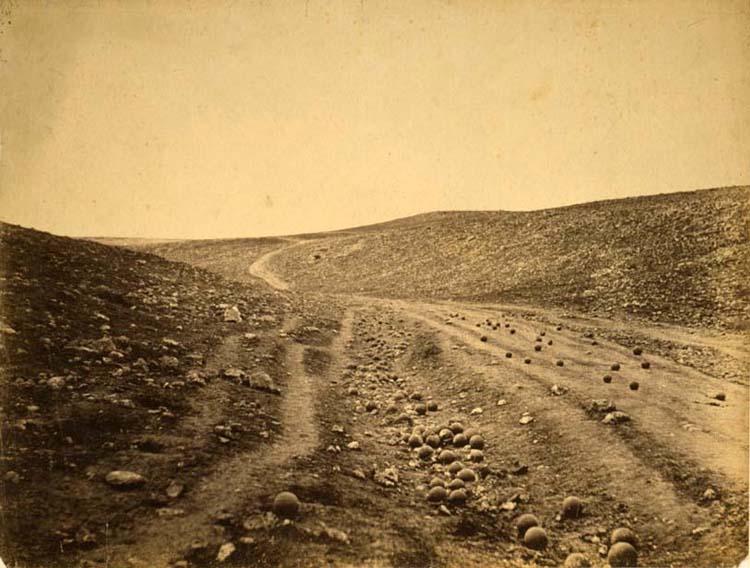
1855 Valley of the Shadow of Death (Charge of Light Brigade) littered with solid cannonballs

Other than Alaska, probably the only lasting good from the horrific Crimean War was that Florence Nightingale would go on to found modern nursing based on her experiences in the Crimean War.  She saved countless lives during the Crimean War, as well as lives that followed in other conflicts--including those in the US War Between the States only five years after the Crimean War.  Confederate medical care adopted Nightingale's discipline.  The Union did not.  Thus, the chance of survival in a Confederate hospital vastly outnumbered one's chance in a Union one.  For example, Captain Sally Louisa Tompkins, the only female commissioned as a Confederate officer, treated over 1300 seriously wounded men.  Of those, only 79 died--a record no other "Civil War" hospital came close to obtaining.  Invited to speak after the war by preeminent Johns Hopkins Hospital, she was asked how she achieved this.  Tompkins said:  "Clean, clean, clean."  (Out of medical supplies she even used kerosene as a cleaner and disinfectant.)  

Anyhow, the Crimean War was one fought over territory and trade.  All of these are usually culprits.  Imperialist Russia's appetite for somebody else's land seems unwhetted even today, as the bullying of Ukraine suggests.  Back in the summer of 1853, Russia occupied (invaded) the Danubian Principalities (Romania and Moldova) which were under Ottoman control. Czarist Russia dismissed the Ottomans as "the sick man of Europe" judging them as too weak to resist the Russian goal to expand and take Turkish lands to open the eastern Mediterranean for Russian control. This specific land grab is normally given as the cause of the war.

Securing promises of international support from Britain and France, the Ottomans declared war on Russia October 4, 1853.  Curiously though, despite claims, the invasion of the Danube was not the actual casus belli of the Crimean War.  It was religion--nothing new under the Sun there either.  

The fight was not between Islam and Christianity and/or Jewish.  Christians in the Holy Lands controlled by the Ottomans had little need of protection.  Rather, protection was sought against internecine fighting in the Holy Land amongst the Christians themselves--specifically between Eastern Orthodox (supported by Russia) and Roman Catholic (supported by France).

Church of the Nativity, photo courtesy CatholicPhilly.com

The row was over who controlled the various Christian holy sites in Bethlehem and Jerusalem.  To diffuse the conflict in 1850, the Ottomans sent the French two keys to the Church of the Nativity.  At the same time, the Ottomans issued a decree to the Russians giving assurances that the keys would not fit the door lock.  Too clever a diplomatic "solution" by half.  The "keys to the door war" escalated. 

In 1852, France under Napoleon III responded to the Ottoman effort to deescalate it.  The self declared Emperor seized control of the holy sites.  Russian Czar Nicholas I viewed the French move as an affront both to Russia and to its Orthodox Church.  The British tried to arbitrate.  And all of a sudden Nicholas I changed his spin and declared Russia's desire for expansion was no longer the priority...all he wanted to do was protect his Christian (Orthodox) communities in the Holy Land.  Uh, right.

So, what does Czar Nicholas I do?  Well, he invades Danube Principalities some 1750 miles distant from the "hot" conflict over the door keys to the Church of the Nativity, "Away in the Manger" notwithstanding.      

The more things change, the more they stay the same.  We've all heard the current excuses about "protecting" Russian speaking people to justify the ongoing criminal war in Ukraine as well.  Russian imperialistic warfare version 2022. 

Incompetence in the Crimean War (on both sides) unnecessarily cost many thousands of lives.  Alfred Lord Tennyson's poem "The Charge of the Light Brigade" memorialized the Battle of Balaclava and the horrific waste basically for nothing. Balaclava also gave us the term "thin red line"--so named for the 93rd Regiment of Foot (Sutherland Highlanders) who withstood a massed Russian cavalry attack that had as its objective the capture of the Balaclava anchorage.  Three companies of the 93rd  Highlanders were all that stood between the massed Russian cavalry and the docks at Balaclava.  Were it not for raw courage and the improved accuracy and range of the Highlanders' new Pattern 1851 Minié rifle (which out ranged Russian muskets by 400 yards) doubtless the Scots would have been overrun, and the British and French efforts in the Crimean War turned into a catastrophic total failure. 

Spring 1855 Balaclava Harbor taken by Roger Fenton; note steamers moored with sailing ships

The Crimean War was the first "modern" war, employing railroads, telegraphs, and explosive naval ordnance versus solid shot.  It was the first war to be covered by reporters and photographers.  It came to symbolize military mismanagement, tactical failures, logistical logjams and medical barbarism until the Treaty of Paris, March 30, 1856 mercifully ended it.

Spring 1855 Balaclava Harbor rail head being laid; taken by Roger Fenton
 

The war was a turning point for Russia.  No question.  It wrecked the Imperial Russian Army and sapped its national treasury.  It would take decades to recover (one of the reasons why the Russian Czar sold off Alaska).  Russian influence in Europe was shattered.  And so too its ambitions upon the eastern Mediterranean.  As is generally the case from armchair generals after a loss, Russian elite (mostly those who didn't fight) sought explanations.  That led to fundamental reform such as the Edict of Emancipation of 1861 abolishing serfdom, not that conditions changed very much for the underclasses in Russia.

Given they had just fought and lost the "modern" Crimean War, czarist Russia began a fast paced program of modernization (at least as imperialist Russia saw things) to recover its lost status in Europe.  If this sounds familiar, it should.  The circumstances are little changed.  Modern technological war, in primitive frozen and muddy trenches.  Ongoing conflict between Catholic and Orthodox.  Land grabs, threats and somewhere, in some wretched barnyard hovel under cold night skies, the Christ child is born.  No room in the inn.  No room in the heart for the Prince of Peace.  The more things change, the more they stay the same. 


[Grammatical note:  An aphorism is a concise, terse expression of a general truth.  The word was first used in Aphorisms of Hippocrates (c. 460 BC - 375 BC). "Ὁ βίος βραχύς, δὲ τέχνη μακρή" - "life is short, art is long".  Ancient aphoristic collections are typically known as wisdom literature, e.g. Book of Ecclesiastes.]


Wednesday, November 30, 2022

Stunning? Nothing to see?

Our walks in Scotland are often off more beaten tourist paths.  This was again true in Inverness ("Capitol of the Highlands") at Easter.  We do not purposefully seek out quirky locations.  We look for the overlooked, the normal, the everyday.  After all, this provides the flavor of a place.

The Muirtown Locks, or "The Cals" as they are locally known, were a planned destination.  Maybe it was an odd choice given any number of alternatives.  But it depends greatly upon one's interests...and upon  realistic expectations.  It's an eye of the beholder deal.  

An example would be the wireless museum in Kirkwall, Orkney this past Easter.  Within a block from our accommodations at The Ayre Hotel, the museum was low hanging fruit, so to speak, if we wanted to see something different.  We thought about it.  But historical radio equipment is not high on our interest list, so we opted to do other things.  No disrespect to the museum. Had we visited it, we would probably have found it quite interesting.  Just not our cup of tea (or coffee).

Doubtless, that same reasoning applies for visitors to the Muirtown Locks.  Travel opinions found online (the thumbs up/thumbs down variety) are of little help.  Online comments regarding the Muirtown Locks ran the gamut from "nothing to see" to "stunning".  "Stunning" is a bit over wrought in this instance.  So too is "nothing to see".  These are canal locks from the Age of Steam at the dawn of the Industrial Revolution.  What would someone expect to see?  

For their part, most Inverness visitors are found near the castle and the numerous area pubs, which is fine.  That has its draw.  In several places, Inverness can be congested with pedestrians.  Incidentally, we too visited a couple pubs in Inverness.  We also walked up to the construction shrouded (no admittance) castle as the starting point of a walk upriver to the Ness Islands.  The walk was crowded with families and small group walkers due to sunshine breaking out.  

The upside to disinterest in the Muirtown Locks was that few people were there in an otherwise busy Inverness. "The Cals" are a flight of four locks in Muirtown at the terminus of the Caledonian Canal in northwest Inverness.  They would probably not be found on most itineraries of the many visitors to this Highland city.  That is a shame.  The locks have quite an engineering history.  

They also reflect our own contemporary problems with large scale projects--like two CalMac ferries that can't seem to get built not with any amount of money or with any measure of time.  The Caldedonian Canal was a big deal.  The largest British government project ever attempted in its day.  According to plans, it was to take 7 years and £350,000 to build.  True to form, it came back over-budget and behind-schedule...taking 17 years to complete at a cost of £840,000.  That's a pretty big miss.


And its biggest problem was that it was not up to "specs".  Work began on the Caledonian Canal in 1803 under the famous Scottish engineer Thomas Telford (1757-1834).  Teleford followed the survey route for the proposal which was laid by the even more famous Scottish mechanical (steam) engineer James Watt 30 years earlier.  James Watt ushered in the Age of Steam in 1765 and eventually industrialism.     

Muirtown is a basin on Beauly/Morray Firth.  The government sought to develop the basin as a second harbor for Inverness through which freight would be transported via the Caledonian Canal, an inland water route running 60 miles via canal works and 29 locks and through several natural lakes in the Great Glen of Scotland; the most famous being Loch Ness.  The canal would link Scotland's east coast (Inverness) to its west coast (Fort William).

The design originated in the Age of Sail.  But that age was soon to be obsolete.  The Age of Steam had already begun, and industrialization was fast approaching.  The raison d'être for the canal was to cut shipping times and increase safety by avoiding sailing the oft treacherous Pentland Firth on Scotland's north coast.  

The canal project claimed a social benefit as well...it would provide local Scotsmen jobs (an ageless recycled political claim still circulating as we speak).  With jobs, that would stem the flow of migration out of the Highlands.  That alleged benevolence must be taken with a huge grain of salt--on the order of a ton of it--given the ongoing Highland Clearances (Fuadach nan Gaidheal) are documented into the 1890s (late Victorian Era).  And in truth, the Clearances only stopped with the advent of the First World War.

Another reason for the project, though not expressly stated, was that the inland canal put British shipping out of the reach of French canons--the Napoleonic Wars were in full swing at this time.  War lent a certain urgency to it.  But wars don't last forever, even though they seem to nowadays.  The canal opened in 1822. 

The canal had problems when it first opened; chief among which was its depth--14 feet versus the planned 20 feet.  Just about the time the canal was finally completed, ship sizes began to increase to improve shipping profitability.  The canal did not have sufficient draft.   Muirtown Basin and the Caledonian Canal could not handle larger ship sizes, and the canal was euphemistically less than successful.  Eventually, in 1844-1847 another construction phase took place and the canal finally met its original design...too little too late.   

Limitation on canal transits are not unfamiliar today.  Modern ships routinely exceed Panama or Suez canals restrictions.  They must either sail around the Capes (e.g. with a Capesize class) or must remain in a specific trade geography with capable ports (e.g. Qatar Max, China Max, Very Large Crude Carriers, etc.)

The Caldeonian Canal missed the boat, to turn the pun.  By the time the canal was finished, steamships had advanced enough to ply the Pentland Firth better than previous sailing ships.  In any case, the "full potential" of the Caledonian Canal was never realized.  Today, Muirtown is a marina, and it seemed more or less full of pleasure craft.  The Caledonian Canal is now almost exclusively used by recreational craft.  We saw no boats of any kind in the canal.

As for Thomas Telford, upon completion of the Caledonian Canal, Parliament passed the "Church of Scotland Act" in 1823 [4 Geo. 4, c. 79], which granted £50,000 to build 32 churches in Highland and Island communities that lacked church buildings and/or to build them in communities with pockets of Catholic or minor denominations.  These were considered "undesirable" by the Church of Scotland.  In any case, these community churches became known as "Telford Parliamentary Kirks". 

Some "Telfords" are still in active use, for example at Portnahaven, Isle of Islay, which we visited in 2017.  Others have been repurposed as art studios, hostels, private homes, and so forth.  Some have been demolished and built over.  

Modern Americans raised on the mantra of "separation of church and state" would probably consider the Telford Kirks an anathema--edifices of a government established religion (which happens to be Presbyterian).  Yet, that retroactively applies modern values (ex post facto if one were to use fancy Latin or constitutional law) to an age already 200 years past.  Back then, not having a house of worship was considered an infringement upon human religious rights.  

The 1823 Act for Building Additional Places of Worship in the Highlands and Islands of Scotland (i.e. the Telford Churches) would not be repealed for 150 years; not until the 1973 Statute Law (Repeals) Act which cleared out old Parliamentary statues that "are no longer of practical utility".

Stunning or not, nothing to see or not, the times they are constantly a'changing.  The Caldedonian Canal speaks that truth.  The visit to hear it was well-spent.